Minden ruhadarab kiegészítése

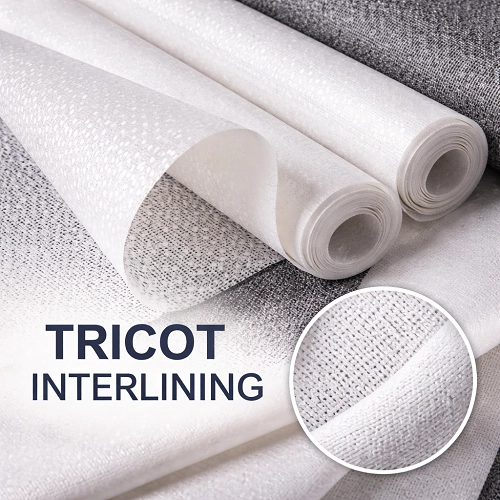
Tricot interlining is an essential component in the world of textiles and garment manufacturing, yet it is often overlooked outside professional circles. At its core, tricot interlining is a specialized fabric used to enhance the performance, structure, hand (feel), and durability of finished garments.
Tricot interlining refers to a type of interlining fabric produced using a tricot knit construction. Interlinings are inserted or bonded between the outer fabric (face) and the garment’s lining to provide shape, support, and sometimes insulation. Tricot interlining, specifically, combines the structural advantages of knit fabrics with functionality tailored for garment reinforcement.
Unlike woven interlinings—which are generally stiffer and more dimensionally stable—tricot interlinings offer elasticity, softness, and improved comfort due to their knit structure.
Tricot fabrics are warp-knitted, meaning the yarns run lengthwise (warp direction) and interloop in a zigzag pattern through adjacent needles. This differentiates them from weft knits (which loop back and forth crosswise) and woven fabrics (which interlace warp and weft yarns).
Tricot interlining can be produced from a variety of fibers or fiber blends, depending on the performance needs of the garment:
| Fiber Type | Typical Properties |
| Polyester | Durable, colorfast, cost-effective, good dimensional stability |
| Nylon (Polyamide) | Excellent abrasion resistance, high strength |
| Spandex/Elastane | Provides stretch and recovery |
| Cotton | Natural, breathable but less dimensional stability |
| Blends | Tuned performance (e.g., durability + comfort + breathability) |
Additives (e.g., anti-static, flame retardants) and finishes (e.g., water repellency) can be applied depending on the end use.Additives (e.g., anti-static, flame retardants) and finishes (e.g., water repellency) can be applied depending on the end use.
Tricot interlining is manufactured on warp knitting machines equipped with guide bars that control yarn movement. The number of guide bars and needle arrangements determine the final loop configuration and fabric properties.
Interlining reinforces areas like collars, cuffs, waistbands, and facings to maintain shape and prevent distortion during wear and laundering.
Due to knit flexibility and softness, tricot interlining contributes to overall garment comfort—especially in curved or dynamic areas like shoulders.
By stabilizing stretch and preventing fabric bagging or sagging, tricot interlining contributes to longer-lasting garment fit.
It helps garments drape better, reduces wrinkling, and contributes to a smoother appearance on the outside surface.
| Feature | Tricot Interlining | Woven Interlining |
| Stretch | Moderate (crosswise) | Low |
| Hand/Softness | Softer | Stiffer |
| Shape retention | Good | Excellent in firm structures |
| Comfort | High | Medium |
| Bulk | Low to moderate | Often higher |
| Best use | Flexible areas, casual to semi-formal | Structured tailoring, formal wear |
Traditional method: fabric and interlining are sewn together during garment construction. Best for bespoke tailoring or areas requiring shaping by stitching.
Features a thermoplastic adhesive on one or both sides. Through heat and pressure (e.g., press), the interlining bonds to the fabric.
Quality depends on adhesive type, activation temperature, and compatibility with face fabric.
In advanced manufacturing, ultrasonic welding or discrete adhesive dot systems can affix interlining without full surface bonding—useful for delicate or technical fabrics.
Interlining should not overpower the intended drape of the garment. Too stiff an interlining in a soft dress can lead to an unintended silhouette.
Fusible vs. sew-in choice influences line speed, quality control, and end performance.
Industry standards from textile organizations (e.g., ASTM, ISO) help ensure consistency and quality.
Assessing lifecycle impact—from raw materials to end-of-life—is becoming part of interlining selection criteria.
Tricot interlining may not be visible to the end consumer, but its impact on garment performance, comfort, and aesthetics is substantial. Its unique combination of knit flexibility, stability, and ease of processing makes it a vital tool in modern apparel design and production. Whether used in casual wear, tailored suits, activewear, or technical textiles, understanding the materials, production methods, and functional requirements of tricot interlining enables better design decisions and improved garment quality.